

The Large Truck Crash Causation Study put driver action or inaction behind 88% of sampled crashes, and weather was rarely the cause
In the Large Truck Crash Causation Study a driver's action or inaction was the critical reason in 88 percent of the sampled crashes. Weather was seldom to blame.
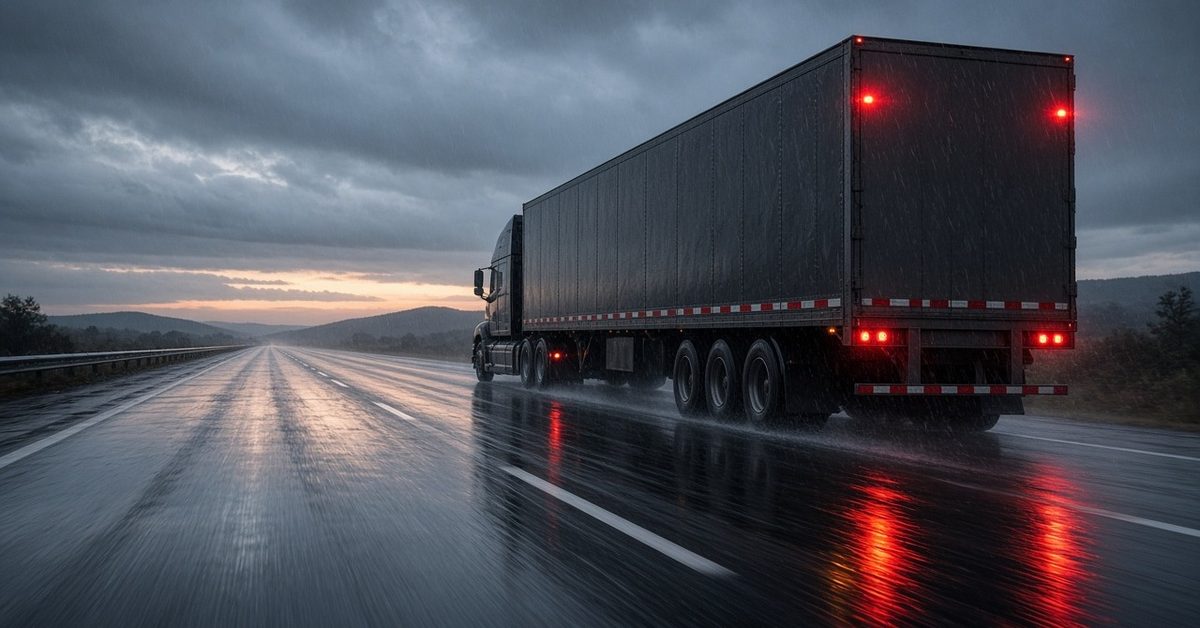
What the notice actually said
The study covered 967 fatal or injury crashes at 24 sites in 17 states between April 2001 and December 2003. They involved 1,127 large trucks and 959 other vehicles, with 251 deaths and 1,408 injuries. This is the sample of the Large Truck Crash Causation Study, not a statistic about our fleet.
The critical reason lay with the driver of the truck or the other vehicle about ten times as often as with weather, road or vehicle. When the study says 88 percent, it means a driver's action or inaction. It does not say truckers caused 88 percent, since the other driver is inside that same 88 percent.
The message of the announcement was to put more effort into driver behavior and into whether the truck is fit to drive, which is still the logic behind inspections. Vehicle defects matter, but in this sample they were not the usual critical reason. Weather is not excluded either; it just was not the typical critical reason.
In LTCCS coding, the critical reason is the last failure in the chain of the crash and not the only contributing factor. Behavior still outranks "it was raining."
At that point it was the first national study of pre-crash factors of its kind. Newer data is available, and this is the original newsroom piece. For us, a crash is still a police report and a preventability review, never an 88 percent caption.
What it changes on Monday
We hire for behavior we can verify: PSP, a road test, the Clearinghouse. We maintain our Volvo tractors. We do not claim that "the study says it is never the truck."
On preventability, see the 2019 proposal. On hiring, see PSP and Open seats.
Our safety team owns the file. A broker who cites 88 percent as "trucks cause it" has misread the sample, so send them this post.
Call +1 (224) 877-0350 if your question is about one of our crashes and not the 2001 to 2003 national study.
What we will and will not do
We will hire for behavior we can verify and keep the truck in good order. We will not claim that "88 percent means it is never the truck," and we will not stretch the sample over a story that only concerns passenger cars.
We will not name weather as the usual culprit because a shipper likes that caption better. The study's critical-reason finding puts behavior first.
Safety keeps the file. Call +1 (224) 877-0350 and a person will answer. For us, a crash is a police report and not a national percentage.
Short glossary
The jargon, in the order it showed up — no extra theory.
- Critical reason
- In LTCCS coding, the last failure in the chain leading to a crash. It is not the only contributing factor.
- LTCCS
- Large Truck Crash Causation Study, the national crash-factor study behind this post.
Official sources
Read the government original first. This page is our translation for people who quote lanes and hire drivers — not a substitute for the rulebook.
- FMCSA Large Truck Crash Causation Study — Primary newsroom original.
This page is an industry briefing for shippers, brokers, and drivers. It is not legal advice. Confirm current rules in the Federal Register and on FMCSA.gov before you change a process.
FAQ
Does 88% mean truckers caused 88%?
No. It refers to the driver of the truck or of the other vehicle, and the other driver is inside that same 88 percent.
Weather never?
Not never. It was not the usual critical reason in this sample. Weather, road and vehicle were the critical reason about ten times less often.
Is it still cited?
Yes, as the baseline national study. Newer data exists, and this post covers the original newsroom piece.
What about our own crash?
It goes through a police report and a preventability review. It is not a blog statistic, and it is not an 88 percent caption on a rate confirmation.
Clarify the next step for your situation
We'll call you back in about 5 minutes — rate, capacity, or driver hire.
Callback in ~5 minutes · no obligation
- Leave a short request
- We clarify your lane, freight, or CDL path
- You get a clear rate or next hiring step